Li-Po Batteries Prolonged Storage Guide
Please note, it has been brought to our attention that this article may be inaccurate. This article was written by a staff writer who is no long employed by us. We have contacted the writer and he has produced his sources which are several articles from "RC Flying" Magazine in Thailand. The source articles do in fact support a lot of the information in the main article. However, though some sources (such as Hirobo Quark's manual as shown in the comment) support the article's claim, many reliable sources show otherwise. We apologize for any inconvenience caused.
Of all the innovation that paved the way to the rise of electric RC flying, battery technology plays one of the biggest roles. Today, modern batteries have a much better power to weight ratio than before. This allows RC airplanes and helicopters to stay in the air for a lengthy period of time - even as long as their nitro counter parts, or even longer. Amongst the types of batteries, Li-Po or Lithium Polymer rates as the best your money can buy. While they cost much less than they used to, it is always wise to make sure that your Li-Po battery will last for as long as it could. This article will provide some pointers as to how to store your Li-Po battery for long periods without sacrificing its overall lifetime.
 If the Li-Po battery is brand new and you decide to keep it for a while before putting it to first use, contrary to common sense, it is best not to store the battery in its uncharged state. The best practice is to fully charge it and maintain it at 4.2 V per cell before storing the battery away for a long time. For example, if you bought a 3-Cell Li-Po battery rated at 11.1 V, when fully charged, the battery will hold 12.6 V. This will make it suitable to keep stored away for 3 to 6 months. However, after 6 months, the voltage will start to weaken. When this happens, fully charge it again, whereby giving another 6 months of storage time. While this procedure can be performed over and over, the battery shouldn't be kept without being used for more than 2 years.
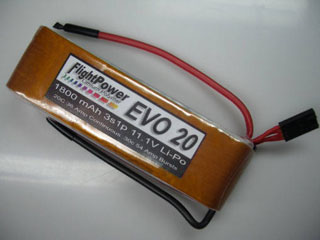
If the Li-Po battery is fairly new and has been used no more than 70 times, has never reached temperature of more than 45 degrees, and never short circuited, the individual cells within the battery needs to be balanced before storage. This easily can be done through new versions of charger which has a "balance cell" function. Another method is to measure the voltage of each cell and set each cell to have an equal voltage to the least-voltage cell. The cells can be discharged using a simple-circuit light bulb making contact with individual cells, whereby slowly draining out each one. Once the cells are balanced, fully charge the battery, which will give each cell about 4.2 V. By doing this, the battery will be ready for a 2 to 4 month-long storage, upon which time the procedure must be repeated. Please note that ultimately, batteries of this condition stored using this procedure should not be kept for more than 1 year.
For batteries that are in a sorry state, such as having been used more than 70 times and have reached temperature higher than 60 degrees and has been short-circuited plenty of times, the first thing to keep in mind is to not hope for much. The procedure for storing these batteries still remains the same as the procedure above. Balance the cells first then charge the battery fully before storage. However, the result won't be great.
As for the storage, keep the battery in a zip-locked bag and place it in a padded aluminum or stainless container (such as a cookie box). Keep the box away from sunlight and humidity. The reason for the stainless box is to protect your house from fire which may be ignited by batteries short-circuiting. Better safe than sorry right?

I purchased a heavy pyrex style covered glass container for my LiPo batteries for storage and charging. It's made to be in a 400 degree oven. Doyou see any problems using it? Also, I've heard the LiPo's can explode. Would the force be enough to blow off the glass top?
rocket75 --- 1:57 Tuesday, 8 August 2008
If you think it won't melt under fire then I think it should be fine. But I think aluminum containers such as cookie boxes like the articles would be the best choice.
2quark4u --- 14:39 Tuesday, 8 August 2008
I'm sorry, but your advice to store Lipo batteries fully charged is
COMPLETELY WRONG!!! All Lipo manufacturers and suppliers advice that you
MUST store Lipo batteries at about 50% charge. Storing at 100%/fully charged will cause an increase in the resistance of the battery, meaning that it may not be able to supply the needed current after a long storage or it will heat up more during flight, causing the battery to die much faster.
To estimate 50% charge, measure the voltage of each battery and it should be between 3.80V - 3.90V..
Lipo batteries also have a shelf life of 2 - 3 years, which means that you should always buy freshly manufactured batteries, not something that has been sitting on a shelf for a few years.
heliguy --- 2:13 Friday, 9 September 2008
| heliguy wrote: |
I'm sorry, but your advice to store Lipo batteries fully charged is COMPLETELY WRONG!!! All Lipo manufacturers and suppliers advice that you MUST store Lipo batteries at about 50% charge. Storing at 100%/fully charged will cause an increase in the resistance of the battery, meaning that it may not be able to supply the needed current after a long storage or it will heat up more during flight, causing the battery to die much faster.
To estimate 50% charge, measure the voltage of each battery and it should be between 3.75V - 3.80V..
Lipo batteries also have a shelf life of 2 - 3 years, which means that you should always buy freshly manufactured batteries, not something that has been sitting on a shelf for a few years. |
Really? That if that is correct that is new information. From what I've heard at local stores and read in helicopter magazines, if you are going to store the battery for more than 2 weeks, then you do have to charge it to 100% like the article said. In fact, when I went to buy my SRB Quark that's what the retailer repeatedly told me (the retailer is an authorized Hirobo store). So now I'm a bit confused.
I am not trying to argue with you but just want to get the information right. Right now, a lot of my batteries of mine are lying around(because I've only been flying the Quark lately and my bigger helis are just gathering dust) and I've charged all those battery packs to 100%. That is also what I've been told, not just by this article but also by a lot of pros and the magazine that I've quoted earlier. So if it's wrong I'm going to go and discharge those pack.
2quark4u --- 5:48 Friday, 9 September 2008
Actually, I've also only hear and read that you're supposed to fully charge your battery before storing it away for a long time. Not just this particular article but other places as well.
In fact, after I read heliguy's comment I went to check my Quark's manual because I remember that it has specific instruction about how to store your battery for extended time. It turns out that Hirobo Quark's manual specifically tells you to fully charge the battery before storage. I've scanned the page:


| mickey_mouse wrote: |
Actually, I've also only hear and read that you're supposed to fully charge your battery before storing it away for a long time. Not just this particular article but other places as well.
In fact, after I read heliguy's comment I went to check my Quark's manual because I remember that it has specific instruction about how to store your battery for extended time. It turns out that Hirobo Quark's manual specifically tells you to fully charge the battery before storage. I've scanned the page:
|
Does anyone know if the new LiFe (A123) batteries will prove to be more practical than LiPos? Since I've become more and more familiar with LiPos, it strikes me that there are a significant number of issues and confusion with them - from safety issues to usage (don't run them down too far or they'll be ruined) to storage issues - not to mention high prices.
| Rc_HeliPilot wrote: |
| Does anyone know if the new LiFe (A123) batteries will prove to be more practical than LiPos? Since I've become more and more familiar with LiPos, it strikes me that there are a significant number of issues and confusion with them - from safety issues to usage (don't run them down too far or they'll be ruined) to storage issues - not to mention high prices. |
Yes it is true that LiPos usage can be quite confusing, but all in all, I think they are easier to use than something like Ni-Mh or Ni-CD. For one thing, they don't suffer from memory effect and can last much much longer. For Ni-MH batteries you have to deplete them before charging or you're going to wear the battery down really quickly. Ni-CD are even worse but for reasons that I've already forgotten 
By the way, what are LiFe batteries? I've never heard of them.
|
Comment form closed due to spams. Please use the forum to post comments instead.
|


